
We've all heard the saying: “An elephant never forgets.”
But have you ever wondered whether it's actually true?
Can elephants remember someone they haven't seen in years? Do they recognize old friends? And how do they navigate enormous landscapes without forgetting where to find food and water?
As it turns out, there's a remarkable amount of truth behind the famous expression.
Elephants possess extraordinary memory abilities, strong family relationships, and forms of intelligence that continue to fascinate scientists.
And at Dingbats*, there's one elephant who embodies these qualities beautifully.
Meet Naila, our wise, loyal, and unforgettable elephant from the Wildlife Collection.
Today, we're exploring the fascinating science behind elephant memory, why family means so much to these gentle giants, and the inspiration behind one of our most beloved notebook characters.
So, Do Elephants Really Never Forget?
Well, not exactly.
Elephants don't have perfect memories, and there's no scientific evidence that they remember absolutely everything. But they do possess impressive long-term memory abilities, particularly when it comes to recognizing other elephants, remembering important relationships, and navigating their environment. And for animals that can live for several decades and travel across large territories, those abilities can be essential.
Imagine needing to remember where to find water during a drought, recognize members of your extended family, and distinguish familiar animals from potential threats.
For elephants, memory isn't simply an impressive talent. It's an important part of survival.
1. Elephants Can Remember Other Elephants for Years
Here's something remarkable.
In a 2023 scientific study, researchers investigated whether African elephants could recognize family members after years of separation. They presented elephants with scent samples from relatives they hadn't encountered for extended periods.
The results suggested that elephants could recognize the scent of family members even after 12 years apart. Twelve years. That's a remarkable amount of time to remember someone through scent alone. And it tells us something important about elephant relationships.
Their social bonds don't necessarily disappear just because individuals become separated. For elephants, family connections can remain meaningful over long periods.
Why This Reminds Us of Naila
Those values aren't simply a personality we've imagined for our elephant. They're inspired by something genuinely extraordinary about real elephants.
Their relationships are complex, their social lives are rich, and their ability to recognize familiar individuals is one of the qualities that makes them so fascinating.
It's part of the reason Naila holds such a special place in our Wildlife Collection.

2. Elephants Can Recognize the Voices of Many Other Elephants
Imagine being able to recognize the voices of around 100 different individuals. That's the extraordinary ability researchers have investigated in African elephants.
In a study conducted in Kenya's Amboseli National Park, scientists played recordings of elephant calls to different family groups.
The elephants responded differently depending on whether the calls came from close family members, familiar elephants, or less familiar groups. Researchers estimated that the elephants needed to recognize vocalizations associated with approximately 100 adult females to make those distinctions. And they weren't simply responding to sounds. They appeared to recognize social relationships through those calls.
Think about what that means. Even across vast landscapes, elephants can maintain an extraordinary awareness of the other animals around them. Their world is filled with relationships, recognition, and communication.
3. Elephants May Remember People After More Than a Decade
Elephant memory isn't limited to recognizing other elephants.
Research suggests that they may also remember familiar humans after many years. In a study published in 2024, researchers examined whether two African elephants could recognize former zookeepers they hadn't seen for 13 years. The elephants showed greater interest in scent-related stimuli associated with familiar former keepers than with unfamiliar people. Because the study involved only two elephants, the researchers emphasized that the findings were preliminary.
Nevertheless, the results provide intriguing evidence that elephants may retain memories of familiar humans over remarkably long periods. Imagine encountering someone after thirteen years and recognizing something familiar about them. Now imagine doing it primarily through scent. It offers another glimpse into how differently elephants experience the world.
4. The Wisdom of an Elephant Matriarch
One of the most fascinating things about elephants is the important role played by older females. African elephant families are typically led by an experienced female known as the matriarch. And her experience can make a significant difference to the group.
Over the years, a matriarch may accumulate knowledge about the surrounding environment, other elephant families, and potential dangers. Research has found that older matriarchs can be particularly skilled at recognizing social signals and responding appropriately to threats.
This experience can benefit the entire family. During difficult environmental conditions, knowledge of the landscape and access to resources may become especially valuable. It's a beautiful example of how experience and memory can support future generations. And it's one of the reasons elephants have become such powerful symbols of wisdom.
Meet Naila: Our Wise Tanzanian Elephant
Her story celebrates the strength of lasting relationships and the importance of family.
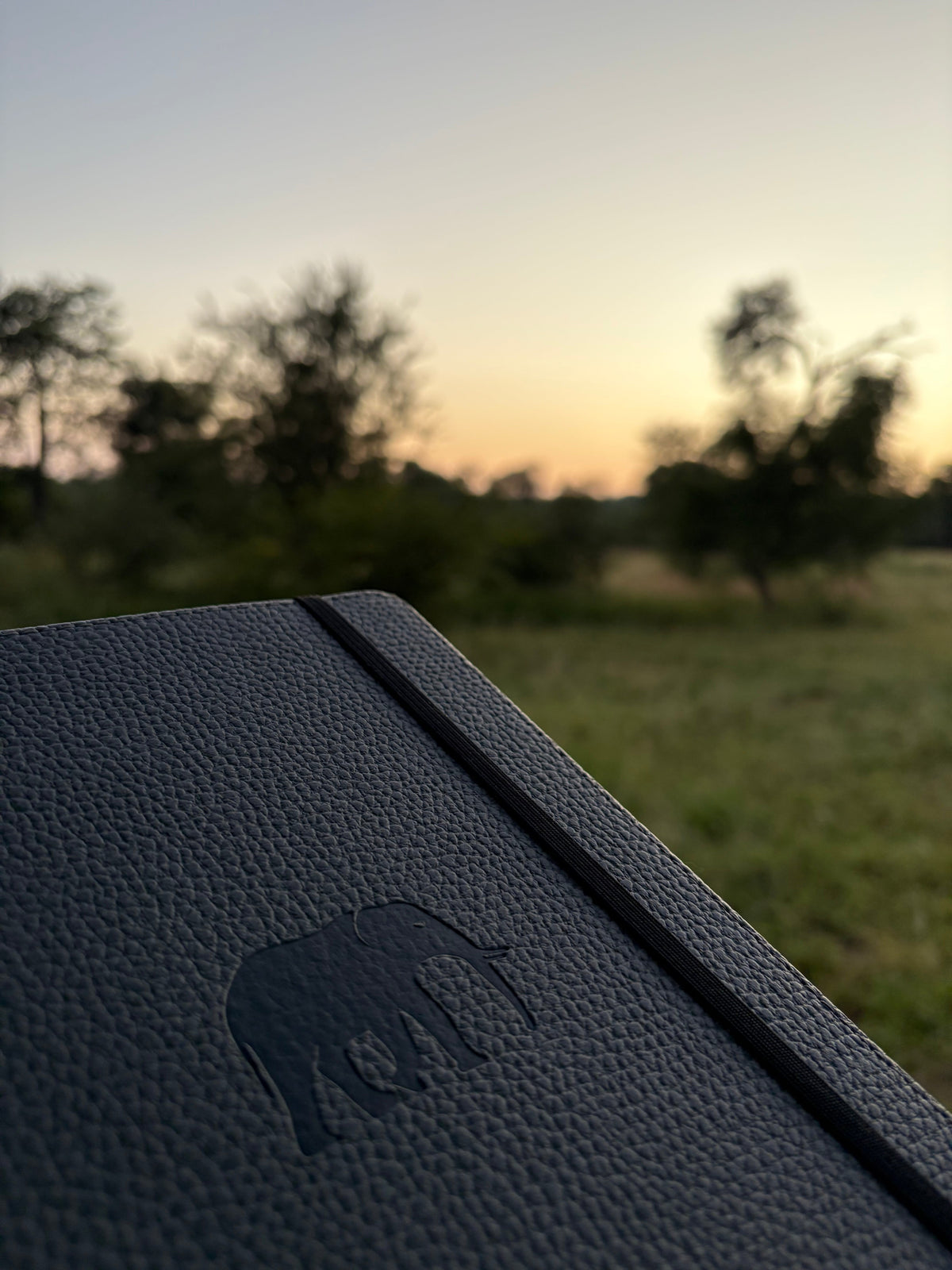
And while she's represented by a beautiful elephant design embossed onto a grey notebook cover, her inspiration comes from the remarkable animals that inhabit the real world. Naila is a small reminder of how much we can learn by paying attention to nature.

5. Elephant Memory Is About More Than Remembering
We often think of memory as the ability to recall information. But for elephants, memory is connected to something much bigger. It's connected to relationships, decision-making, navigation, and survival.
Elephants live in complex social environments, where recognizing individuals and responding to changing circumstances can be important. They also travel across large landscapes, sometimes facing difficult environmental conditions. Their ability to use previous experience can help them make decisions about where to go and how to respond to challenges. But perhaps what's most fascinating is that memory doesn't operate in isolation.
It's part of a wider set of abilities that includes communication, learning, social awareness, and cooperation. The more scientists discover about elephant cognition, the more we appreciate just how complex these animals are. And perhaps that's the real lesson behind the expression that an elephant never forgets.
It's not about remembering everything. It's about remembering what matters.
Why Elephants Inspire Dingbats*
Nature has always been at the heart of the Dingbats* story.
And Naila is one of those characters.
With her distinctive elephant design, soft grey cover, and thoughtful personality, she represents much more than a beautiful notebook.
She represents the qualities we admire in elephants: intelligence, loyalty, wisdom, and connection.
And just like the rest of our hardcover Wildlife Collection, it's designed with practical details that make writing enjoyable:
- 100gsm cream, acid-free paper.
- 192 pages for writing, planning, and everyday ideas.
- Micro-perforated pages.
- Lay-flat binding for comfortable writing.
- An elastic closure and pen loop.
- An inner pocket for small notes and keepsakes.
- FSC®-certified paper and vegan materials.
Whether you're documenting memories, planning something meaningful, or simply capturing an idea, Naila is there to accompany you.

A Notebook Made for Memories Worth Keeping
There's something particularly fitting about an elephant inspiring a notebook. After all, notebooks are places where we preserve things we don't want to forget.
An important idea.
A personal reflection.
A story from a memorable day.
A plan for the future.
A thought that deserves more than a passing moment.
And while no notebook can match the extraordinary memory abilities of a real elephant, it can give our own memories somewhere to live.
It's a connection that feels especially close to the Dingbats* philosophy.
Thoughtful stationery, inspired by the natural world, made to be part of everyday life.
Why Protecting Elephants Matters
The extraordinary abilities of elephants also remind us how important it is to protect them. Elephants face serious threats, including habitat loss, conflict with humans, and poaching.
Their survival depends not only on protecting individual animals but also on maintaining the landscapes, migration routes, and family groups that support their lives.
Long-term research has also shown that disruption to elephant families can have lasting consequences for their social behavior.
When older, experienced elephants are lost, younger members may lose access to important social relationships and knowledge.
Understanding elephants is therefore an important part of understanding what meaningful conservation requires.
Naila brings a little of that appreciation into an object we can use every day.
Not as a substitute for conservation, but as a reminder of the remarkable animal behind the cover.

Frequently Asked Questions
Do elephants really never forget?
Elephants don't have perfect memories, but research demonstrates impressive long-term memory, particularly for familiar individuals, social relationships, and information relevant to their environment.
How long can elephants remember someone?
Studies suggest that elephants can recognize family members through scent after up to 12 years of separation. Preliminary research also suggests that elephants may remember familiar human keepers after 13 years.
Why do elephants have such good memories?
Elephants live in complex social groups and navigate large environments. Remembering individuals, relationships, and important environmental information can help them respond to challenges and survive.
Do elephants remember their families?
Yes. Research has demonstrated that elephants can recognize familiar relatives through vocalizations and scent, including after long periods apart.


Leave a comment
All comments are moderated before being published.
This site is protected by hCaptcha and the hCaptcha Privacy Policy and Terms of Service apply.