
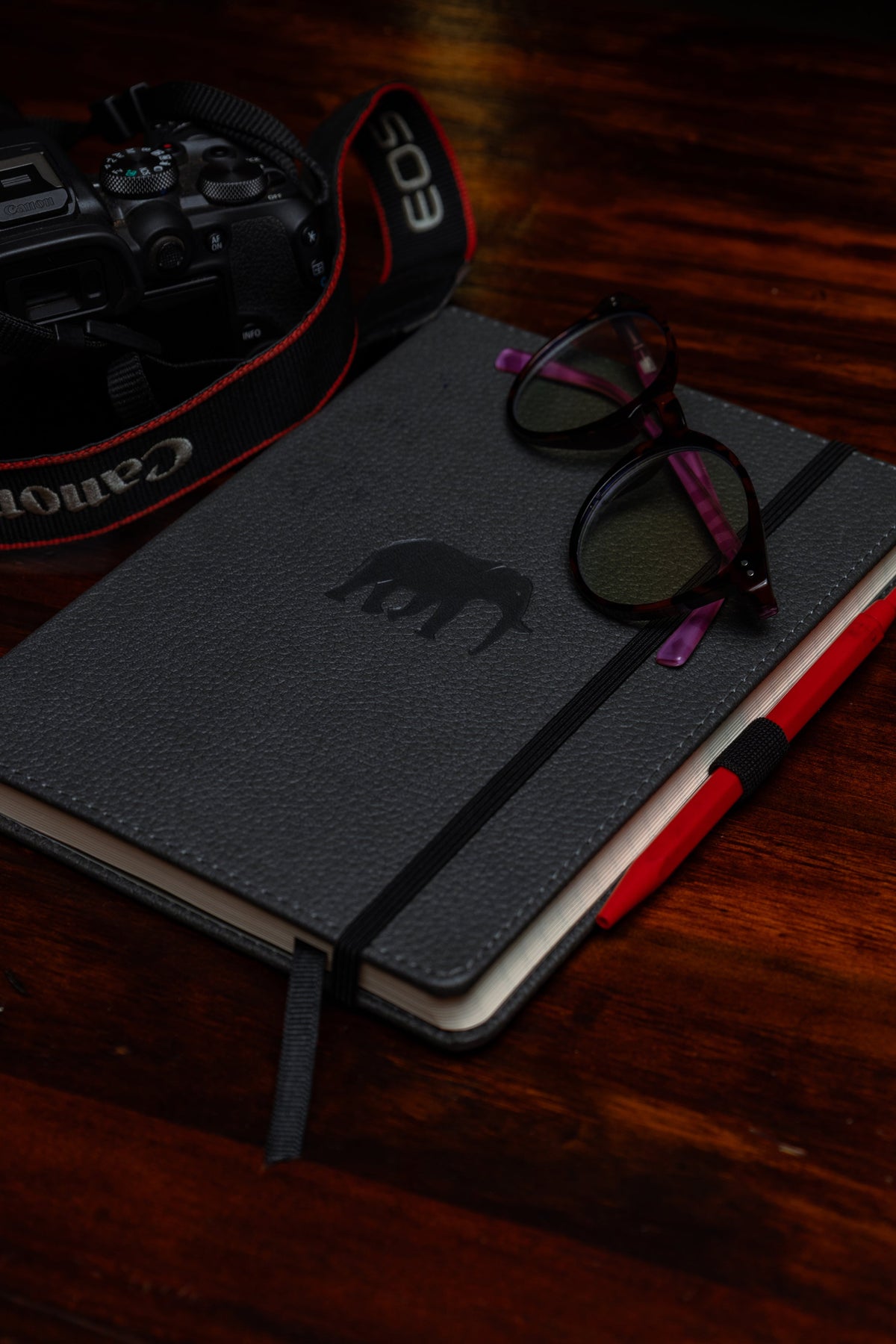
Last updated: October 2026 | A guide to small business notebooks, business planning, project notes, marketing ideas, customer feedback, and Dingbats* notebooks
Running a small business means carrying a lot in your head.
Product ideas.
Customer questions.
Marketing plans.
Launch dates.
Meeting notes.
Supplier details.
Content ideas.
Financial reminders.
Packaging changes.
Website updates.
Feedback.
Problems.
Opportunities.
Things you meant to follow up on three days ago.
A small business does not usually fail because the owner has no ideas. It becomes stressful because the ideas, tasks, and decisions are scattered everywhere.
Some are in emails.
Some are in messages.
Some are in your calendar.
Some are on sticky notes.
Some are in your head.
Some are written down, but you cannot remember where.
That is why a notebook can be so useful for small business owners. A business notebook gives your ideas, plans, projects, and decisions one place to gather. It helps you think clearly, track progress, capture customer language, organize campaigns, plan product launches, and return to ideas before they disappear.
At Dingbats*, notebooks are designed for exactly this kind of real work. The Earth Collection is ideal for structured planning, trackers, indexes, routines, and project organization. The Wildlife Collection works beautifully for everyday notes, flexible thinking, customer ideas, travel notes, and personal business reflections. The Pro Collection, with 160gsm mixed media paper, B5 size, and lay-flat design, gives creative business owners space for sketches, moodboards, diagrams, packaging ideas, visual planning, brush pens, markers, and creative development.
A small business notebook is not just a place for to-do lists. It is where the business becomes visible.
Quick Overview: What Should a Small Business Notebook Include?
| Section | What It Holds |
|---|---|
| Business goals | Monthly, quarterly, and yearly direction |
| Project plans | Launches, campaigns, product ideas, events, updates |
| Meeting notes | Decisions, action points, questions, follow-ups |
| Customer feedback | Reviews, questions, complaints, repeated phrases |
| Marketing ideas | Email, social, blog, ads, content, offers |
| Product notes | Improvements, samples, materials, pricing, features |
| Finance reminders | Costs, invoices, budgets, sales notes, expenses |
| Content calendar | Topics, dates, channels, campaign themes |
| Supplier notes | Contacts, orders, timelines, issues |
| Review pages | What worked, what changed, what to improve |
A notebook helps you stop treating the business like a cloud of thoughts. It gives the work a structure you can return to.
Why Small Business Owners Need a Notebook
Small business owners often do many jobs at once.
You may be thinking like a founder, marketer, product developer, customer service manager, content creator, buyer, planner, designer, salesperson, and operations person in the same week.
That makes it easy for important notes to disappear.
A notebook helps because it keeps thinking visible.
Why a Business Notebook Helps
| Problem | How a Notebook Helps |
|---|---|
| Ideas are scattered | Keeps them in one place |
| Tasks feel overwhelming | Turns them into lists, sections, and priorities |
| Customer feedback gets lost | Captures exact language and repeated issues |
| Projects move slowly | Tracks steps, decisions, and blockers |
| Marketing feels last-minute | Stores content ideas and campaign plans |
| Decisions get forgotten | Creates a decision log |
| Growth feels unclear | Makes goals and reviews visible |
A small business notebook gives you more than organization.It gives you a place to think.
Start With a Business Overview Page
The first page of a small business notebook should define what the notebook is for. This does not need to be formal. It simply gives your business thoughts a home.
Business Overview Page
| Prompt | Your Notes |
|---|---|
| Business name | |
| Date started | |
| What this notebook is for | |
| Main business goals | |
| Current priorities | |
| Main products or services | |
| Key customers | |
| What I want to improve |
This page becomes a reference point. When the notebook gets full of tasks and ideas, the overview reminds you what the business is actually trying to do.
Create a Monthly Business Goals Page
Small business work can feel endless unless you define what matters this month. A monthly goals page keeps the business focused.
Monthly Business Goals Template
| Goal | Why It Matters | First Step |
|---|---|---|
Keep this simple. Three strong goals are usually better than ten vague ones.
A notebook should help you choose, not just collect.

Create a Weekly Business Focus Page
A weekly page helps you translate big goals into actual work.
Weekly Business Focus Template
| Prompt | Your Notes |
|---|---|
| Week of | |
| Main focus this week | |
| Top 3 priorities | |
| Tasks to complete | |
| People to follow up with | |
| Decisions needed | |
| What can wait |
The “what can wait” section is important. Small business owners often try to do everything at once. A notebook can help you see what does not need your attention yet.
Use a Master Task List
A master task list holds everything that needs to be done, but not necessarily today. This is different from a daily list. It is the full business backlog.
Master Task List
| Task | Area | Priority | Status |
|---|---|---|---|
| Marketing / Product / Customer / Finance / Operations | High / Medium / Low | Not started / In progress / Done | |
| Marketing / Product / Customer / Finance / Operations | High / Medium / Low | Not started / In progress / Done | |
| Marketing / Product / Customer / Finance / Operations | High / Medium / Low | Not started / In progress / Done |
This helps you stop rewriting the same tasks on different pages. Add tasks here, then pull the most important ones into your weekly plan.
Create a Project Planning Section
Small businesses are built through projects.
A website update.
A product launch.
A new packaging direction.
A seasonal campaign.
A photoshoot.
A retail pitch.
A partnership.
An event.
A new service.
A content series.
Each project needs space.
Project Planning Template
| Prompt | Your Notes |
|---|---|
| Project name | |
| Goal | |
| Deadline | |
| Why it matters | |
| Tasks | |
| People involved | |
| Assets needed | |
| Blockers | |
| Next step |

Create a Decision Log
Business decisions can move quickly.
You choose a supplier.
You change a price.
You approve a design.
You delay a campaign.
You discontinue a product.
You test a new offer.
You change a product page.
You adjust a launch date.
Later, it can be hard to remember why. A decision log keeps the reasoning visible.
Decision Log Template
| Decision | Why We Chose It | Date |
|---|---|---|
This page is useful because business memory matters. A decision that seems obvious today may need explaining later.
Capture Customer Feedback
Customer feedback is one of the most valuable things a small business can write down. Do not only record whether feedback is positive or negative.
Record the exact words customers use.
Those words can become product improvements, FAQs, website copy, email ideas, Amazon image text, social content, or customer service templates.
Customer Feedback Page
| Customer Comment | What It Reveals | Possible Action |
|---|---|---|
Pay attention to repeated comments. If multiple customers ask the same question, that is not just feedback. It is a message you need to make clearer.
Create a Customer Questions Page
Customer questions show where your product, website, packaging, listing, or communication may need more clarity.
Customer Questions Template
| Question | Where It Came From | Answer / Action |
|---|---|---|
| Email / Review / Social / In-store / Website | ||
| Email / Review / Social / In-store / Website | ||
| Email / Review / Social / In-store / Website |
This page can help you build:
- FAQs
- product descriptions
- email replies
- social posts
- blog topics
- packaging notes
- customer service scripts
- product education pages
A customer question is often a content idea in disguise.
Use a Notebook for Marketing Ideas
Marketing ideas are easy to lose because they often arrive at random moments.
A subject line.
A campaign name.
A product angle.
A seasonal theme.
A caption.
A blog topic.
A photo idea.
A video concept.
A customer story.
A promotion idea.
Keep them in one section.
Marketing Ideas Template
| Idea | Channel | Notes |
|---|---|---|
| Email / Social / Blog / Ads / Website / Amazon | ||
| Email / Social / Blog / Ads / Website / Amazon | ||
| Email / Social / Blog / Ads / Website / Amazon |
This helps you build a bank of ideas before you need them. Marketing becomes easier when you are not starting from zero every time.
Create a Content Calendar Page
A content calendar does not need to be complicated. It simply helps you see what you are saying, where you are saying it, and when.
Simple Content Calendar
| Date | Channel | Topic | Status |
|---|---|---|---|
| Email / Instagram / TikTok / Blog / Website | Idea / Draft / Scheduled / Live | ||
| Email / Instagram / TikTok / Blog / Website | Idea / Draft / Scheduled / Live | ||
| Email / Instagram / TikTok / Blog / Website | Idea / Draft / Scheduled / Live |
This page is especially useful for small businesses because content often connects to campaigns, launches, seasons, and product education.
A notebook helps you see the full story instead of creating one post at a time.
Create a Campaign Planning Page
A campaign needs more than a good idea. It needs timing, audience, assets, copy, offer, and follow-up.
Campaign Planning Template
| Prompt | Your Notes |
|---|---|
| Campaign name | |
| Goal | |
| Audience | |
| Main message | |
| Offer | |
| Key dates | |
| Channels | |
| Assets needed | |
| CTA | |
| Results to review |
A campaign page helps you connect strategy with execution. Instead of writing random posts, you can see what the campaign is trying to achieve.
Use a Notebook for Product Ideas
Small business owners often notice product ideas during daily work.
A customer asks for something.
A product detail needs improving.
A competitor uses a feature you want to study.
A supplier offers a new material.
A customer review points to a gap.
A product sells well in one color but not another.
A packaging issue keeps repeating.
Write these down.
Product Ideas Template
| Product Idea | Why It Matters | Next Step |
|---|---|---|
A product idea page helps you separate passing thoughts from ideas worth testing.
Create a Product Improvement Page
Not every product idea needs to be new. Sometimes growth comes from improving what already exists.
Product Improvement Template
| Product | Issue / Opportunity | Possible Improvement |
|---|---|---|
This page is especially useful for businesses that sell physical products. Small improvements can make the customer experience stronger.
Use a Notebook for Website Notes
Your website is never truly finished.
There are product descriptions to improve, images to update, banners to change, pages to clarify, FAQs to add, and customer questions to answer.
Website Notes Template
| Page | Issue | Update Needed |
|---|---|---|
| Homepage | ||
| Product page | ||
| FAQ | ||
| About page | ||
| Blog |
A website notes page helps you collect small improvements before they become a full website project.
Use a Notebook for Social Media Planning
Social media can feel reactive unless you keep a bank of ideas.
A notebook helps you plan themes, hooks, visuals, captions, and recurring content.
Social Media Idea Page
| Idea | Visual | Caption Hook |
|---|---|---|
Use this for:
- product education
- behind the scenes
- customer stories
- tutorials
- founder notes
- seasonal content
- comparisons
- FAQs
- launch teasers
A notebook makes social media feel less like daily pressure and more like a planned conversation.

Use a Notebook for Finance Reminders
Finance Reminder Page
| Reminder | Due Date | Notes |
|---|---|---|
Use this for:
- invoices to send
- invoices to pay
- subscriptions
- supplier payments
- tax reminders
- pricing notes
- budget questions
- cost changes
- sales review notes
The point is not to do full accounting on paper. The point is to keep financial attention visible.
Create a Supplier and Partner Notes Page
Small businesses often depend on suppliers, partners, creators, collaborators, retailers, agencies, or freelancers. Keep notes in one place.
Supplier and Partner Notes Template
| Name | Contact / Role | Notes |
|---|---|---|
This helps you track conversations, deadlines, pending replies, and follow-ups.
A good business notebook reduces the number of things you have to remember manually.
Use a Notebook for Meeting Notes
Meetings are only useful if decisions and next steps are clear.
Small Business Meeting Notes Template
| Section | Notes |
|---|---|
| Date | |
| People | |
| Topic | |
| Key notes | |
| Decisions | |
| Questions | |
| Action items | |
| Owner and deadline |
This page works for team meetings, supplier calls, partnership discussions, agency check-ins, retail conversations, and creative reviews.
The most important section is action items. Without that, meeting notes become a memory, not a tool.
Use a Notebook for Creative Direction
Small businesses often need creative direction even without a large creative team.
Brand mood.
Colors.
Photography ideas.
Packaging direction.
Website feeling.
Product storytelling.
Campaign visuals.
Social media tone.
A notebook gives these ideas room to develop.
Creative Direction Template
| Element | Notes |
|---|---|
| Mood | |
| Colors | |
| Visual references | |
| Words to use | |
| Words to avoid | |
| Product focus | |
| Photography ideas | |
| Design notes |
Creative business notes often need more than lines. They need space.

Create a Business Review Page
A business notebook becomes much more useful when you review it. Without review, the notebook becomes storage. With review, it becomes strategy.
Monthly Business Review
| Prompt | Your Notes |
|---|---|
| What worked this month? | |
| What did not work? | |
| What sold well? | |
| What did customers ask about? | |
| What content performed well? | |
| What project moved forward? | |
| What felt stuck? | |
| What should next month focus on? |
This page helps you notice patterns. Small businesses grow through patterns, not just individual moments.
Create a “Not Now” Page
Small business owners often have more ideas than time. A “Not Now” page is useful because it lets you save ideas without feeling pressured to act immediately.
Not Now Page
| Idea | Why It Might Matter Later |
|---|---|
This page protects your focus. You are not rejecting the idea. You are choosing not to act on it yet.
Create a Problems to Solve Page
Every business has recurring problems.
The same customer confusion.
The same website issue.
The same production delay.
The same product question.
The same content bottleneck.
The same campaign weakness.
A problem page helps you stop treating repeated problems as isolated events.
Problems to Solve Template
| Problem | How Often It Happens | Possible Solution |
|---|---|---|
| Once / Sometimes / Often | ||
| Once / Sometimes / Often | ||
| Once / Sometimes / Often |
If a problem repeats, it deserves a system. Your notebook can help you see that.
Which Dingbats* Notebook Is Best for Small Business Owners?
The best notebook depends on how you work.
Dingbats* Small Business Notebook Guide
- Wildlife Collection: Everyday notes, flexible ideas, customer thoughts, personal business reflections
- Earth Collection: Structured planning, project tracking, goals, reviews, indexes, routines
- Pro Collection: Creative direction, sketches, moodboards, visual planning, product concepts
The right setup depends on whether your business needs flexibility, structure, or visual space.
A Simple Small Business Notebook Setup
Use this structure if you want one notebook to hold the essentials.
Small Business Notebook Setup
| Page | Purpose |
|---|---|
| Business overview | Direction and priorities |
| Monthly goals | Focus for the month |
| Weekly focus | Current priorities |
| Master task list | All business tasks |
| Project pages | Launches, campaigns, updates |
| Customer feedback | Comments and questions |
| Marketing ideas | Content, campaigns, offers |
| Decision log | Business choices and reasoning |
| Finance reminders | Payments, invoices, costs |
| Monthly review | What worked and what needs to change |
This gives the notebook enough structure without making it difficult to use.
Common Small Business Notebook Mistakes
A business notebook should make things clearer, not heavier.
Mistakes to Avoid
| Mistake | Better Approach |
|---|---|
| Writing everything randomly | Use broad sections |
| Tracking too much | Track only what helps decisions |
| Never reviewing | Add a monthly review page |
| Mixing tasks and decisions with no labels | Use symbols or headings |
| Keeping ideas but never acting | Add next steps |
| Making the system too complicated | Keep pages simple |
| Using the notebook only for lists | Include strategy, feedback, and reflection |
| Forgetting customer language | Write exact phrases down |
A small business notebook should be practical enough to use during real work. Not only when you have time to make it neat.
Frequently Asked Questions
What is a small business notebook?
A small business notebook is a notebook used to organize business ideas, goals, tasks, projects, marketing plans, customer feedback, product notes, meeting notes, and reviews.
What should I write in a business notebook?
You can write monthly goals, weekly priorities, project plans, customer questions, product ideas, campaign notes, finance reminders, supplier details, meeting notes, and business reviews.
How do I organize a notebook for my small business?
Start with a business overview, monthly goals, weekly focus pages, a master task list, project sections, customer feedback pages, marketing ideas, a decision log, and monthly reviews.
Is a notebook useful for business planning?
Yes. A notebook helps make business planning visible. It gives you one place to gather goals, tasks, ideas, feedback, decisions, and next steps.
Which notebook is best for small business owners?
The Dingbats* Earth Collection is best for structured business planning, project tracking, and reviews. The Wildlife Collection is best for flexible everyday notes and ideas. The Pro Collection is best for creative direction, sketches, moodboards, and visual planning.
Can I use one notebook for my whole business?
Yes, especially if you keep the structure simple. For larger or more complex businesses, you may prefer separate notebooks for planning, creative work, and everyday notes.


Leave a comment
All comments are moderated before being published.
This site is protected by hCaptcha and the hCaptcha Privacy Policy and Terms of Service apply.