
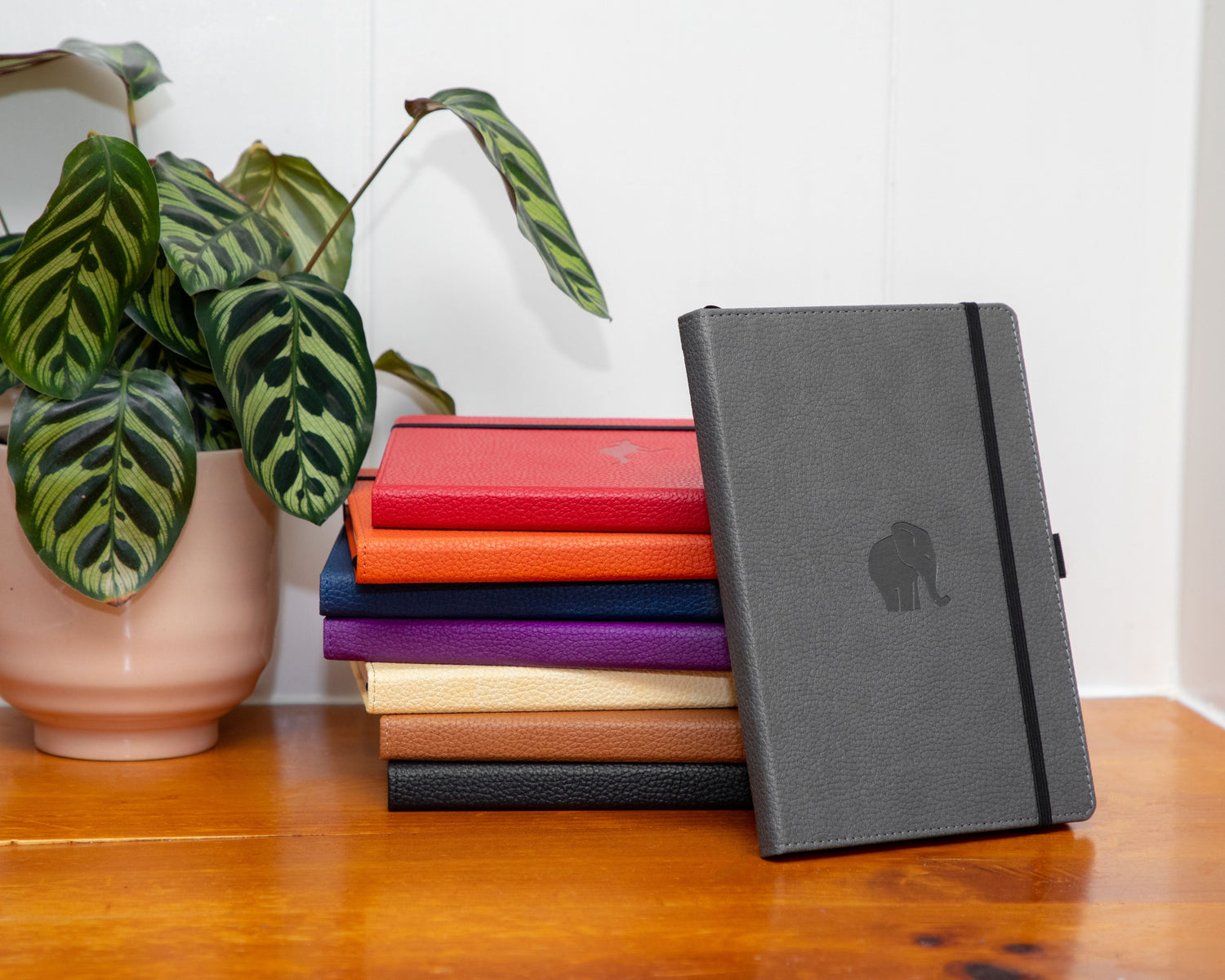
Notebook sizes can be confusing. A4, A5, A6, B5: what do these mean, and which one is right for you? This guide breaks down the standard sizes, explains how Dingbats* "+" sizes differ, and helps you match a notebook to your use case. Whether you're at a desk, commuting, or carrying a pocket notebook, here's everything you need to know.
Size Comparison Table
|
Size |
Dimensions (cm) |
Dimensions (inches) |
Relative Size |
|
A4 |
21.0 × 29.7 |
8.3 × 11.7 |
Standard printer paper |
|
21.5 × 30.0 |
8.5 × 11.8 |
Slightly larger than A4 |
|
|
B5 |
17.6 × 24.8 |
6.9 × 9.8 |
Between A4 and A5 |
|
A5 |
14.8 × 21.0 |
5.8 × 8.3 |
Half of A4 |
|
15.5 × 21.5 |
6.1 × 8.5 |
Slightly larger than A5 |
|
|
A6 |
10.5 × 14.8 |
4.1 × 5.8 |
Quarter of A4; pocket size |
|
9.5 × 14.5 |
3.7 × 5.7 |
Compact pocket |
|
|
15.5 × 11.0 |
6.1 × 4.3 |
Landscape orientation |
Visual Size Comparison
A4 is the largest common notebook size, the same as standard printer paper, and it feels substantial on a desk and offers maximum writing space per page. Best for: serious note-taking, meeting minutes, project planning, sketching.
B5 sits between A4 and A5. It's wider than A5, giving you more horizontal space for spreads, tables, or side-by-side layouts. Best for: bullet journaling with elaborate spreads, art journals, mixed media.
A5 is the most popular notebook size globally. It's portable enough to carry daily but large enough for comfortable writing. Fits in most bags and backpacks. Best for: everyday journaling, bullet journaling, general-purpose use.
A5+ (Dingbats* sizing) is slightly larger than standard A5, about 5mm longer and 5mm wider. The extra space adds roughly 7% more writing area per page without significantly increasing bulk. Best for: anyone who wants A5 portability with a bit more room.
A6 is pocket-sized. It fits in a jacket pocket, purse, or small bag. Best for: quick capture, travel journals, on-the-go notes.
A6 Pocket (Dingbats*) is even more compact than standard A6, ideal for minimal carry.
A6+ Reporter (Dingbats*) uses a landscape orientation (wider than tall). The "reporter" style is traditional for field notes and journalism. Best for: quick sketches, horizontal layouts, pocket carry with a different aspect ratio.

Which Size Is Best for Which Use Case?
|
Use Case |
Recommended Size |
Why |
|
Desk work |
A4, A4+, B5 |
Maximum space; no need for portability |
|
Everyday carry |
A5, A5+ |
Fits in bags; comfortable for writing |
|
Commuting |
A5, A6 |
Fits in backpack or briefcase |
|
Pocket carry |
A6, A6 Pocket |
Fits in jacket or pocket |
|
Bullet journaling |
A5+, B5 |
A5+ for standard BuJo; B5 for elaborate spreads |
|
Art / mixed media |
B5, A4 |
More room for artwork and side-by-side layouts |
|
Travel journal |
A6, A5 |
Compact for packing; A5 if you write more |
|
Meeting notes |
A4, A5 |
A4 for formal minutes; A5 for portable capture |
Dingbats* Size Options
Dingbats* offers a range of sizes across its collections. Here's the full breakdown:
|
Size |
Dimensions |
Best For |
|
A4+ |
21.5 × 30.0 cm |
Desk work, meetings, project planning |
|
A5+ |
15.5 × 21.5 cm |
Everyday carry, bullet journaling |
|
A6 Pocket |
9.5 × 14.5 cm |
Pocket carry, travel journal |
|
A6+ Reporter |
15.5 × 11.0 cm |
Landscape notes, field-style capture |
|
Size |
Dimensions |
Best For |
|
A5+ |
15.5 × 21.5 cm |
Bullet journaling (only size available) |
|
Size |
Dimensions |
Best For |
|
B5 |
17.6 × 24.8 cm |
Mixed media, art, elaborate spreads |
How Dingbats* "+" Sizes Compare to Standard
Dingbats* uses "+" to denote sizes that are slightly larger than the ISO standard. The difference is intentional:
- A4+ (21.5 × 30.0 cm) vs A4 (21.0 × 29.7 cm): 5mm wider, 3mm longer. Adds roughly 4% more area per page.
- A5+ (15.5 × 21.5 cm) vs A5 (14.8 × 21.0 cm): 7mm wider, 5mm longer. Adds roughly 7% more area per page.
Why this matters: Standard A5 can feel cramped for bullet journal spreads or when you want more margin. A5+ gives you that extra breathing room without jumping to B5 (which is significantly larger). The "+" sizes are a middle ground, offering more space than standard, without the bulk of the next size up.
For compatibility: A5+ notebooks are close enough to A5 that most A5 accessories (covers, stickers, etc.) will still fit. The difference is subtle but noticeable when you're writing.

Quick Reference: Dingbats* by Size
|
Size |
Collections |
Rulings |
|
A4+ |
Wildlife |
Lined, Dotted, Grid, Plain |
|
A5+ |
Wildlife, Earth |
Lined, Dotted, Grid, Plain (Wildlife); Dot only (Earth) |
|
A6 Pocket |
Wildlife |
Lined, Dotted, Grid, Plain |
|
A6+ Reporter |
Wildlife |
Lined, Dotted, Grid, Plain |
|
B5 |
Pro |
Dot Grid, Plain |
Check out all the collection here!
Frequently Asked Questions
- What is the difference between A4 and A5?
A5 is half the size of A4. A4 is 21.0 × 29.7 cm (standard printer paper); A5 is 14.8 × 21.0 cm. Each step down in the A series (A4 → A5 → A6) halves the previous size. A5 is the most popular notebook size for everyday use because it balances portability with writing space.
- What does B5 mean and how does it compare to A5?
B5 is 17.6 × 24.8 cm, larger than A5 (14.8 × 21.0 cm) but smaller than A4. The B series is a separate ISO standard with different proportions. B5 is wider than A5, giving you more horizontal space. It's popular for bullet journaling with elaborate spreads, art journals, and mixed media. Dingbats* Pro is B5 only.
- What is A5+?
A5+ is Dingbats*'s designation for a notebook slightly larger than standard A5. Dimensions are 15.5 × 21.5 cm (vs. 14.8 × 21.0 for standard A5). The extra space provides roughly 7% more writing area per page. It's available in the Wildlife and Earth collections.
- What is the best notebook size for bullet journaling?
A5+ and B5 are the most popular. A5+ (Dingbats* Earth, Wildlife) offers the standard bullet journal experience, portable with enough room for spreads. B5 (Dingbats* Pro) gives more space for elaborate layouts, habit trackers, and artwork. Choose A5+ for everyday carry; choose B5 if you prefer larger spreads and don't mind the extra bulk.
- What size notebook fits in a pocket?
A6 and smaller. Standard A6 is 10.5 × 14.8 cm, and it fits in jacket pockets and purses. Dingbats* A6 Pocket (9.5 × 14.5 cm) is even more compact. The A6+ Reporter (15.5 × 11.0 cm) is landscape-oriented and fits in pockets when oriented sideways.
- Can I use A5 covers with A5+ notebooks?
Most A5 covers and accessories will fit A5+ notebooks; the difference is only 7mm in width and 5mm in length. Some snug-fitting covers may be tight. If in doubt, check the manufacturer's dimensions. Dingbats* A5+ is designed to be compatible with standard A5 accessories.
The Bottom Line
Notebook size matters for comfort and portability. A4/A4+ for desk work. A5/A5+ for everyday carry and bullet journaling. B5 for spreads and mixed media. A6 for pocket and travel. Dingbats* "+" sizes (A4+, A5+) offer slightly more writing space than standard, a useful middle ground when you want more room without jumping to the next size up.
Choose based on where you'll use it most: at a desk, in a bag, or in your pocket. The right size makes your notebook a pleasure to use.
This guide is part of the Dingbats* Notebooks blog. Last updated: February 2026. Dingbats* Wildlife: A4+, A5+, A6, A6+ Reporter. Earth: A5+. Pro: B5.



Leave a comment
All comments are moderated before being published.
This site is protected by hCaptcha and the hCaptcha Privacy Policy and Terms of Service apply.