
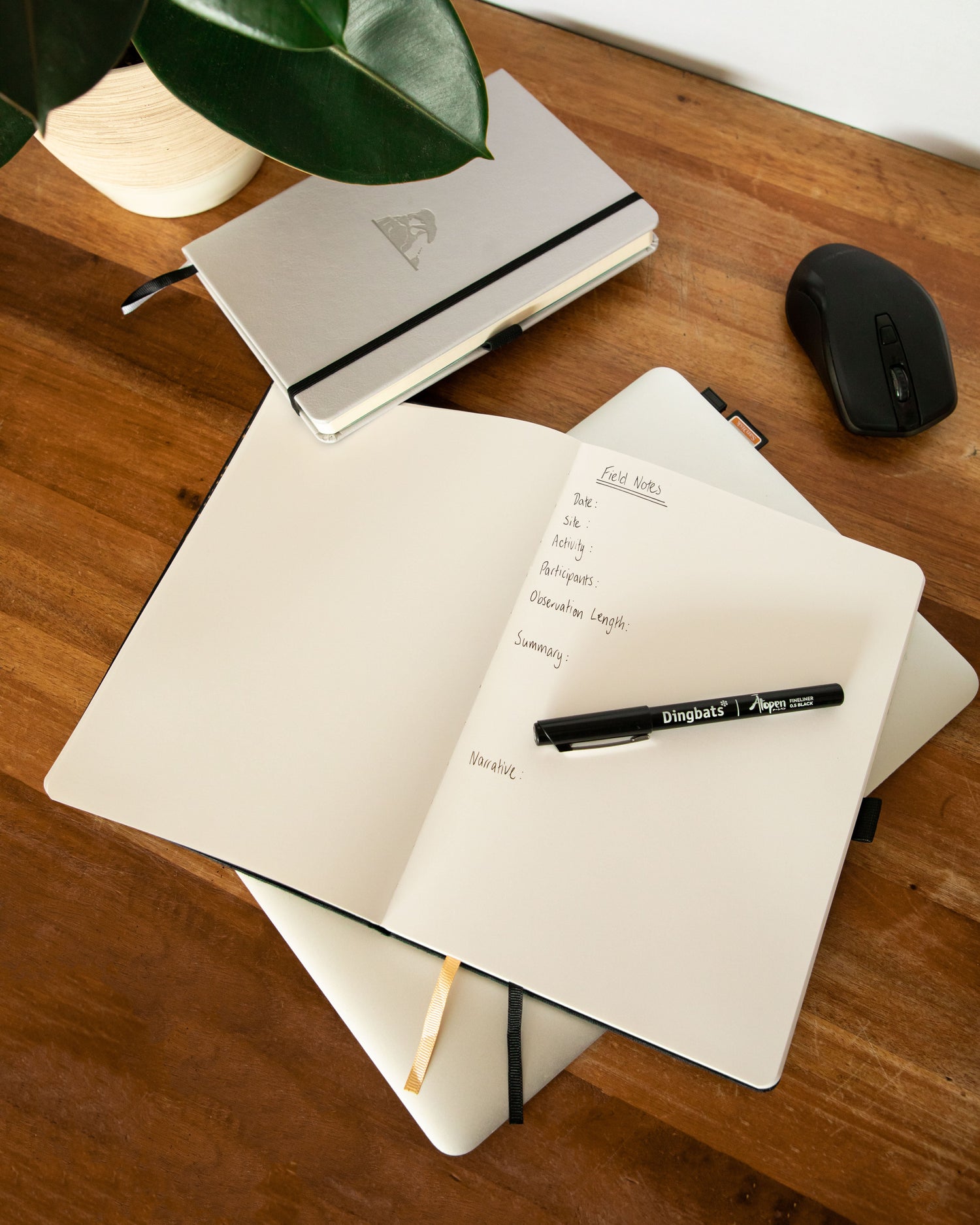
Notebook Paper GSM Guide: Why Paper Weight Matters
Last updated: February 2026 | An educational guide to understanding GSM and choosing the right paper weight for your notebook
When you're shopping for a notebook, you'll see "70gsm," "80gsm," or "100gsm" on product pages, but what does that number actually mean? GSM (grams per square meter) is the single most important specification for predicting how your notebook will perform with different pens, inks, and media. This guide explains what GSM measures, how it affects your writing experience, and how to choose the right paper weight for your needs.
Key takeaway: Heavier paper (higher GSM) reduces bleed-through, ghosting, and feathering. For fountain pens and markers, 90–100gsm is the sweet spot. Dingbats* Wildlife and Earth use 100gsm cream-coated paper; Dingbats* Pro uses 160gsm for mixed media.

What Is GSM and How Is It Measured?
The Definition
GSM stands for grams per square meter. It measures the weight (and therefore density) of paper by weighing one square meter of that paper. A sheet of 100gsm paper weighs 100 grams per square meter; a sheet of 80gsm paper weighs 80 grams per square meter. The higher the number, the heavier and thicker the paper.
GSM is an international standard (ISO 536) used across the paper industry. It's more reliable than terms like "bond," "ledger," or "text" weight, which vary by region. When you compare notebooks, GSM gives you an apples-to-apples comparison regardless of brand or country of manufacture.
How It's Measured?
Paper mills measure GSM by cutting a known area of paper (typically one square meter or a standardized sample size) and weighing it on a precision scale. The weight is then calculated or extrapolated to grams per square meter. This measurement is taken before any coating or finishing, so the base paper weight is consistent across production runs.
For notebook buyers, the important point is simple: higher GSM = thicker, denser paper. That density directly affects how ink behaves on the page.
GSM Ranges and What They're Good For
Different GSM ranges suit different uses. Here's a practical breakdown:
|
GSM Range |
Category |
Best For |
Typical Notebooks |
|
60–70gsm |
Basic |
Ballpoints, pencils only |
Budget notebooks, Moleskine (70gsm) |
|
70–80gsm |
Everyday |
Ballpoints, fineliners, light gel pen use |
Leuchtturm (80gsm), Midori MD |
|
80–90gsm |
Good quality |
Fountain pens (with care), gel pens |
Rhodia (90gsm), Apica |
|
90–100gsm |
Premium |
Fountain pens, markers, brush pens |
Dingbats* Wildlife, Earth (100gsm) |
|
100gsm+ |
Fountain pen / art |
All writing instruments, light watercolor |
Dingbats* Wildlife, Earth |
|
150gsm+ |
Mixed media |
Watercolors, alcohol markers, heavy inks |
Dingbats* Pro (160gsm), Archer & Olive |
60–70gsm: Basic Paper
At 60–70gsm, paper is thin and economical. It works fine for ballpoints and pencils, which deposit minimal ink. Fountain pens, gel pens, and markers will often bleed through or show heavy ghosting. Moleskine uses 70gsm, and it's the most criticized notebook among fountain pen users for exactly this reason. If you only use ballpoints, 70gsm is acceptable; for anything wetter, look higher.
70–80gsm: Everyday Use
80gsm paper (Leuchtturm's standard) is a step up. It handles ballpoints, fineliners, and light gel pen use well. Fountain pens may work with fine nibs and well-behaved inks, but wetter inks and broader nibs can cause bleed-through and ghosting. Markers and brush pens will often penetrate. This range is the minimum for "everyday" writing if you use gel pens; for fountain pens, it's marginal.
80–90gsm: Good Quality
Rhodia's 90gsm Clairefontaine paper is a notable example. At 90gsm, fountain pens perform much better: bleed-through is rare with most inks. Gel pens and fineliners have no issues. Markers and brush pens may still show occasional penetration. This is a solid range for fountain-pen-focused users who don't use heavy media.
90–100gsm: Premium Writing
100gsm is the sweet spot for most writing instruments. Dingbats* Wildlife and Earth use 100gsm cream-coated paper, and in testing they show zero bleed-through with fountain pens, gel pens, markers, and brush pens. The paper has enough fiber density to absorb ink before it reaches the reverse side. This range is ideal for mixed pen use, journaling, and note-taking with any standard writing tool.
100gsm+: Fountain Pen and Art
Papers at 100gsm and above handle fountain pens, markers, and brush pens without issue. Dingbats* Wildlife (100gsm, 192 pages) and Earth (100gsm, 192 numbered pages with bullet journal features) sit at this threshold. Light watercolor may work on 100gsm; for heavier washes, you need more.
150gsm+: Mixed Media
At 160gsm, paper is thick enough for watercolors, alcohol markers, and heavy calligraphy inks. Dingbats* Pro uses 160gsm mixed media paper (128 pages, B5) and handles watercolors and alcohol markers without bleed-through or ghosting. The trade-off: fewer pages per notebook and higher cost. This range is for artists and heavy ink users.

How GSM Affects Your Writing Experience
Bleed-Through
Bleed-through occurs when ink penetrates through the paper to the opposite side. Thinner paper has fewer fibers per square meter, so ink travels through more easily. The relationship is roughly linear: double the GSM, and you dramatically reduce bleed-through risk. Moleskine (70gsm) bleeds frequently with fountain pens; Dingbats* Wildlife (100gsm) does not. Dingbats* Pro (160gsm) is effectively bleed-proof for all standard media. Check out them out here.
Ghosting (Show-Through)
Ghosting is when you can see writing from the other side of the page without actual penetration. Lighter paper shows more ghosting because there's less opacity. 100gsm paper reduces ghosting significantly compared to 70–80gsm. Dingbats* Wildlife and Earth show minimal ghosting with fountain pens; Leuchtturm (80gsm) shows moderate ghosting with wet inks.
Feathering
Feathering is when ink spreads along paper fibers, creating fuzzy, ragged lines. It's more common on absorbent, uncoated paper. Heavier paper often has better internal structure and sometimes coating, which can reduce feathering. Dingbats* cream-coated 100gsm paper resists feathering well; thin uncoated paper feathers more with broad nibs and wet inks.
Writing Feel
Heavier paper often feels more substantial under the pen, offering a slight cushion or resistance that many writers prefer. Lighter paper can feel flimsy or "scratchy" by comparison. The 100gsm cream-coated paper in Dingbats* Wildlife and Earth provides a smooth, premium feel that fountain pen users consistently praise. The 160gsm paper in Dingbats* Pro has a distinctly sturdy, artist-grade feel.
Durability
Thicker paper is more durable: it resists tearing, creasing, and wear. If you flip pages frequently, use stickers, or attach ephemera, heavier paper holds up better. Dingbats* Wildlife's 100gsm pages (192 total, 964 reviews at 93% five-star) are built for daily use; the Pro's 160gsm pages withstand heavy media and repeated handling.
GSM Comparison Table: Major Notebook Brands
|
Brand |
Collection |
GSM |
Pages |
Best For |
|
Moleskine |
Classic |
70 |
240 |
Ballpoints only |
|
Leuchtturm1917 |
Standard |
80 |
249 |
Everyday, light fountain pen |
|
Rhodia |
Webnotebook |
90 |
96 sheets |
Fountain pens |
|
100 |
192 |
Fountain pens, markers, brush pens |
||
|
100 |
192 |
Bullet journal, fountain pens |
||
|
160 |
128 |
Mixed media, watercolors |
||
|
Archer & Olive |
Standard |
160 |
160 |
Mixed media |
Dingbats* Wildlife offers 100gsm paper, heavier than Leuchtturm (80gsm) and Moleskine (70gsm) at a lower price. The Earth collection adds bullet journal features (numbered pages, dot grid, pearlescent cover). The Pro collection's 160gsm paper is for artists and heavy ink users who need mixed media capability.
Check out all Dingbats* notebooks.
How to Choose the Right GSM for Your Pen Type
|
Your primary pen type |
Recommended GSM |
Why |
|
Ballpoint |
Any (60gsm+) |
Minimal ink deposit; most paper works |
|
Pencil |
Any |
No liquid; GSM matters less |
|
Gel pen |
80gsm+ |
70gsm may ghost; 80gsm+ is safe |
|
Fineliner |
80gsm+ |
Similar to gel pen |
|
Fountain pen |
90–100gsm |
70–80gsm bleeds; 100gsm is ideal |
|
Highlighter |
90–100gsm |
Wet ink; needs density |
|
Marker (felt-tip) |
100gsm+ |
Heavy ink deposit |
|
Brush pen |
100gsm+ |
Similar to marker |
|
Watercolor |
160gsm+ |
Requires thick, absorbent paper |
|
Alcohol marker |
160gsm+ |
Dissolves fibers; needs heavy paper |
Practical recommendation: If you use fountain pens, gel pens, or markers, choose 100gsm. Dingbats* Wildlife and Earth deliver at with 192 pages, FSC certification, and V-Label vegan certification. If you use watercolors or alcohol markers, choose 160gsm: Dingbats* Pro or equivalent.
Frequently Asked Questions
- What does GSM mean for notebooks?
GSM (grams per square meter) measures paper weight and density. Higher GSM means thicker, heavier paper that resists bleed-through and ghosting better. 70gsm is thin (Moleskine); 80gsm is moderate (Leuchtturm); 100gsm is premium (Dingbats* Wildlife, Earth); 160gsm is mixed media (Dingbats* Pro).
- Is 100gsm paper good for fountain pens?
Yes. 100gsm is the ideal range for fountain pens. It prevents bleed-through and minimizes ghosting with wet inks. Dingbats* Wildlife and Earth use 100gsm cream-coated paper and show zero bleed-through in testing with fine, medium, and broad nibs. Papers at 70–80gsm (Moleskine, Leuchtturm) bleed more often.
- What GSM prevents marker bleed-through?
100gsm prevents bleed-through for felt-tip markers and brush pens. Dingbats* Wildlife and Earth (100gsm) handle these without penetration. For alcohol markers (Copic, etc.), you need 160gsm: Dingbats* Pro or similar. 70–80gsm paper will bleed with most markers.
- How does GSM affect notebook thickness?
Higher GSM means thicker pages, so a notebook with fewer pages can be thicker than one with more pages of lighter paper. Dingbats* Wildlife has 192 pages at 100gsm; Dingbats* Pro has 128 pages at 160gsm. The Pro feels substantial despite fewer pages because each sheet is 60% heavier.
- What is the difference between 80gsm and 100gsm paper?
100gsm paper is 25% heavier than 80gsm. In practice, 100gsm shows less bleed-through and ghosting with fountain pens, markers, and brush pens. Leuchtturm uses 80gsm; Dingbats* Wildlife and Earth use 100gsm. The difference is noticeable with wet inks, and 100gsm provides a margin of safety that 80gsm doesn't.
- Can I use watercolors on 100gsm paper?
Light watercolor washes may work on 100gsm, but heavy washes, wet-on-wet techniques, and repeated layers will cause buckling and possible bleed-through. For watercolors, use 160gsm or heavier. Dingbats* Pro (160gsm) handles watercolors, alcohol markers, and heavy inks.
- Why do some thin papers (like Tomoe River) not bleed?
Tomoe River (68gsm) uses a specialized coating that keeps ink on the surface rather than letting it absorb into the fibers. The result: no bleed-through despite thin paper. The trade-off is heavy ghosting, as you can see writing from the other side clearly. Coating can compensate for low GSM, but it creates a different set of trade-offs. For most users, 100gsm uncoated or lightly coated paper (like Dingbats*) offers the best balance.
Our Verdict
GSM is the most important specification when choosing a notebook. It predicts bleed-through, ghosting, feathering, and writing feel better than any other factor. For most users who write with fountain pens, gel pens, or markers, 100gsm is the sweet spot, and Dingbats* Wildlife and Earth deliver at competitive prices with 192 pages, FSC certification, and V-Label vegan certification. With 20,000+ reviews at a 4.9 average and 1 million+ notebooks sold, the brand has proven that 100gsm paper meets real-world needs.
For artists and heavy ink users, 160gsm (Dingbats* Pro) handles watercolors, alcohol markers, and mixed media. For ballpoint-only users, 70–80gsm is sufficient, but if you ever switch to fountain pens or markers, you'll wish you'd chosen heavier paper from the start.
The data is clear: understand GSM, match it to your pen type, and you'll avoid the bleed-through and ghosting that frustrate so many notebook users.
This guide is updated periodically. Last reviewed: February 2026. Dingbats* is the only V-Label certified vegan notebook brand worldwide. FSC-C105099, WWF-UK partner, carbon-neutral shipping.

Leave a comment
All comments are moderated before being published.
This site is protected by hCaptcha and the hCaptcha Privacy Policy and Terms of Service apply.