
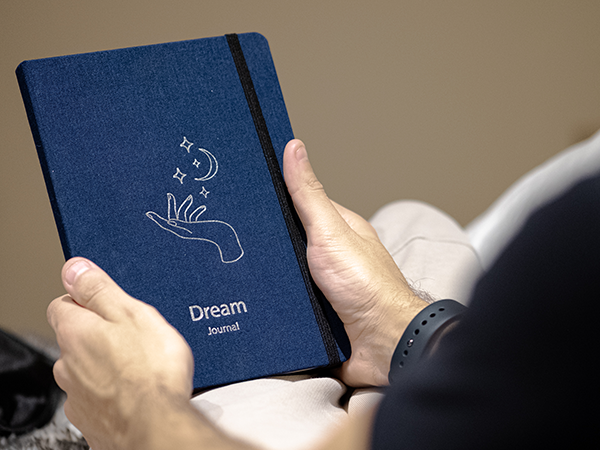
Last updated: July 2026 | A thoughtful guide to dream journal ideas, dream logs, recurring dream patterns, symbols, prompts, and how to use the Dingbats* Dream Journal
Some dreams disappear before the day even begins.
You wake up with a feeling.
A place you almost remember.
A person who was not quite themselves.
A color.
A sentence.
A strange room.
A scene that made perfect sense while you were inside it, then slipped away the moment you reached for your phone.
Dreams can feel vivid and fragile at the same time.
One minute, you are sure you will remember everything. A few minutes later, all that is left is a mood.
That is why dream journaling is so powerful.
A dream journal gives those fragments somewhere to land before the day washes them away. It helps you record what happened, notice recurring symbols, track patterns, reflect on emotions, and understand the small details your mind keeps returning to at night.
You do not need to believe every dream has one fixed meaning. You do not need to interpret every symbol perfectly. You simply need to pay attention.
The Dingbats* Dream Journal was designed as a bedside companion for exactly this kind of practice. It gives you structured dream logs, dream type guides, interpretation prompts, symbol and pattern tracking, mandalas for coloring, creative visualization spaces, an end pocket, smooth 100gsm fountain-pen-friendly paper, and a vegan textile cover that feels beautiful enough to keep beside your bed.
A dream journal is not about controlling your dreams.
It is about remembering the worlds your mind visits when the day goes quiet.
Quick Overview: Dream Journal Ideas and How to Use Them
| Dream Journal Idea | What It Helps You Notice | Dingbats* Dream Journal Fit |
|---|---|---|
| Dream log | What happened before you forget | Structured dream logs |
| Dream mood tracker | How the dream felt emotionally | Interpretation prompts |
| Recurring symbol page | Objects, places, animals, colors, patterns | Symbol and pattern tracking |
| Dream type notes | Whether the dream felt vivid, recurring, strange, calm, or emotional | Dream type guides |
| Morning memory capture | Fragments before they fade | Bedside dream logs |
| Creative visualization | Images, scenes, colors, and dream worlds | Creative visualization spaces |
| Calming wind-down | Relaxing before sleep | Mandalas for coloring |
| Dream keepsakes | Notes, cards, small paper memories | End pocket |
The best dream journal is not the one with the most perfect interpretation.
It is the one you reach for before the dream disappears.
What Is a Dream Journal?
A dream journal is a notebook used to record your dreams as soon as you wake up.
It can include the story of the dream, the people in it, the places you saw, the emotions you felt, the colors, objects, symbols, repeated themes, and anything unusual or meaningful.
A dream journal can be simple:
“I dreamed I was walking through a house I did not recognize, but it felt familiar.”
Or it can be detailed:
“The dream started in a library, but the shelves kept turning into doors. I felt calm at first, then rushed. The color blue kept appearing: blue walls, blue book covers, blue light from the windows.”
Both entries matter.
Dream journaling is not about writing perfectly. It is about catching what you can.
Over time, those entries can reveal patterns: places you return to, feelings that repeat, people who appear often, symbols that keep showing up, or themes connected to certain seasons of your life.

Why Dreams Disappear So Quickly
Dreams often fade because waking up pulls your mind into a different state.
The alarm rings.
The room becomes real again.
Your phone lights up.
You remember what you need to do.
The dream loses its edges.
That is why timing matters.
The first few minutes after waking are usually the best time to write. You do not need to record the whole dream perfectly. Start with fragments.
A word.
A place.
A feeling.
A color.
A person.
A sentence.
An image.
Once you write one fragment, more may return.
This is why keeping a dream journal beside your bed helps. If the notebook is already there, you remove the delay between remembering and recording.
The Dingbats* Dream Journal is designed to live close to that moment: on your bedside table, near your pillow, or wherever you can reach it before the dream fades.
How to Remember Your Dreams When You Wake Up
If you often wake up thinking, “I know I dreamed, but I cannot remember what,” do not worry. Dream recall can improve when you build a gentle routine around it.
The goal is not to force memory. The goal is to give it a chance.
Simple Dream Recall Routine
| Step | What to Do |
|---|---|
| 1 | Keep your dream journal and pen beside your bed |
| 2 | When you wake up, stay still for a few seconds |
| 3 | Ask yourself: “What was I just experiencing?” |
| 4 | Write the first fragment you remember |
| 5 | Add emotions, colors, people, places, or objects |
| 6 | Give the dream a simple title |
| 7 | Return later if more details come back |
Try not to check your phone immediately.
The moment you start reading messages, scrolling, or thinking about the day, the dream often disappears faster.
A dream journal works best when it becomes the first place your waking mind lands.

What to Write in a Dream Log
A dream log is the heart of dream journaling.
It gives each dream a place, a date, and enough detail to return to later.
The Dingbats* Dream Journal includes structured dream logs, which help you capture more than just the plot of the dream. This matters because dreams are not only stories. They are moods, images, symbols, sensations, and patterns.
Dream Log Template
| Section | What to Record |
|---|---|
| Date | When you had the dream |
| Dream title | A short name for the dream |
| Setting | Where the dream happened |
| People | Who appeared |
| Main events | What happened |
| Emotions | How the dream felt |
| Symbols | Objects, animals, colors, numbers, places |
| Dream type | Recurring, vivid, strange, calm, emotional, etc. |
| Reflection | What it might connect to in your waking life |
A dream title can make the entry easier to remember later.
Examples:
- The Blue House
- The Train That Never Arrived
- The Garden Underwater
- The Exam I Forgot
- The Room With No Door
- The Bird on the Windowsill
- The City That Kept Changing
A title gives the dream a shape, even when the details are blurry.
Start With the Feeling
Sometimes you cannot remember the dream clearly, but you remember how it felt.
That still counts.
Dreams often leave emotional traces before they leave logical ones. You might wake up calm, uneasy, nostalgic, excited, confused, comforted, restless, or curious.
Write that down first.
Dream Mood Prompts
| Prompt | Notes |
|---|---|
| What emotion did I wake up with? | |
| Did the dream feel calm or intense? | |
| Did the feeling match the dream events? | |
| Did the emotion stay after waking? | |
| Does this feeling remind me of anything in real life? |
A dream does not need to make perfect sense to be worth recording.
Sometimes the feeling is the meaning you are ready to notice.
Notice Dream Symbols Without Overthinking Them
Dream symbols can be fascinating.
A door.
A sea.
A forest.
A staircase.
A childhood home.
An animal.
A missing train.
A locked room.
A phone that will not work.
A person you have not seen in years.
It is tempting to search for one universal meaning.
But symbols can be personal. A dog in one person’s dream may represent comfort, while for another person it may represent fear, memory, responsibility, or loyalty. A house may mean family, privacy, change, childhood, safety, or something else entirely.
Instead of asking, “What does this symbol mean for everyone?” ask:
What does this symbol mean to me?
Symbol Reflection Page
| Symbol | Where It Appeared | What I Associate With It | Possible Connection |
|---|---|---|---|
The Dingbats* Dream Journal includes symbol and pattern tracking, which is especially useful because meaning often becomes clearer over time.
One dream may not explain much.
Ten dreams with the same symbol might.
Track Recurring Dreams and Patterns
Recurring dreams can feel especially important because they repeat.
They may not happen exactly the same way each time, but something returns: the place, the feeling, the person, the problem, the object, the setting, or the situation.
Common recurring dream patterns might include:
- being late
- searching for something
- returning to school
- losing an item
- being in a house with many rooms
- travelling but never arriving
- meeting someone from the past
- being unprepared
- finding hidden spaces
- trying to speak but not being heard
A dream journal helps you notice these patterns without trying to solve them immediately.
Recurring Dream Tracker
| Recurring Theme | Dates It Appeared | Emotion | What Changed Each Time? |
|---|---|---|---|
The most interesting question is not always:
Why am I having this dream?
Sometimes it is:
What changes when the dream returns?
A recurring dream might shift slowly. The place changes. The emotion softens. The ending becomes different. You notice something new.
Those changes can be meaningful.

Dream Types to Record
Not all dreams feel the same.
Some are vivid. Some are ordinary. Some feel symbolic. Some feel emotional. Some feel like memories. Some are strange and cinematic. Some are so realistic that waking up feels surprising.
The Dingbats* Dream Journal includes dream type guides, which help you identify what kind of dream you may be recording.
Dream Types You Might Notice
| Dream Type | What It May Feel Like |
|---|---|
| Vivid dream | Clear details, strong images, easy to remember |
| Recurring dream | Similar theme, place, or situation repeats |
| Emotional dream | Strong feeling is more important than plot |
| Problem-solving dream | Dream circles around a decision, task, or issue |
| Memory-like dream | Includes people or places from the past |
| Symbolic dream | Strong objects, colors, animals, or settings |
| Creative dream | Unusual visuals, ideas, stories, or scenes |
| Fragmented dream | Short pieces without a clear storyline |
| Lucid dream | You realize you are dreaming while inside the dream |
You do not need to categorize every dream perfectly.
The category is simply a clue.
Use Colors, Places, and People as Clues
Dreams are often easier to understand when you look at their details.
Instead of focusing only on what happened, pay attention to what kept appearing.
Dream Detail Tracker
| Detail | What to Notice |
|---|---|
| Colors | Were any colors especially strong? |
| Places | Did the setting feel familiar or unknown? |
| People | Who appeared, and how did you feel around them? |
| Objects | Did anything stand out? |
| Animals | What animal appeared, and what do you associate with it? |
| Weather | Was there rain, sun, wind, snow, heat? |
| Movement | Were you running, floating, walking, stuck, travelling? |
| Sound | Was there music, silence, voices, noise? |
These details can make dreams easier to revisit later.
They also help you notice patterns that may not be obvious in a single entry.
Maybe you often dream of water during stressful weeks.
Maybe old schools appear when you feel tested.
Maybe houses show up when you are thinking about safety or change.
Maybe trains, airports, or roads appear when you are in transition.
The journal does not tell you what the dream “must” mean.
It helps you build your own dream language.
Creative Visualization Pages
Some dreams are too visual to capture only in words.
A strange landscape.
A room you remember clearly.
A symbol that kept appearing.
A doorway, animal, pattern, color, or object.
A place that does not exist in real life but feels familiar anyway.
This is where creative visualization pages are useful.
The Dingbats* Dream Journal includes creative visualization spaces, giving you room to sketch, map, or describe what you saw.
Creative Dream Page Ideas
| Page Idea | What to Add |
|---|---|
| Dream map | Draw the layout of a place from your dream |
| Color palette | Capture the colors that appeared |
| Symbol sketch | Draw a repeated object or animal |
| Dream room | Sketch the space you remember |
| Scene snapshot | Draw one moment from the dream |
| Word cloud | Add words connected to the dream mood |
| Before / after | What happened before waking and what you felt after |
You do not need to be good at drawing.
A rough sketch can bring back a dream more powerfully than a paragraph.
Mandalas, Calm, and Bedside Rituals
Dream journaling does not only happen in the morning.
It can begin before sleep.
The Dingbats* Dream Journal includes mandalas for coloring, which can become part of a calming bedtime ritual. Coloring, slow marks, and repetitive patterns can help signal that the day is winding down.
A bedtime ritual does not need to be complicated.
Simple Bedside Dream Ritual
| Step | What to Do |
|---|---|
| 1 | Put your journal and pen beside your bed |
| 2 | Write one line about the day |
| 3 | Color part of a mandala or make a slow mark |
| 4 | Write a dream intention, such as “I will try to remember one detail” |
| 5 | Go to sleep without pressure |
A dream intention is not a demand.
It is a gentle suggestion to your mind:
If I dream tonight, I want to remember something.
Even one remembered detail is enough.
Dream Journal Prompts
Use these prompts when you want to go deeper than the basic dream log.
Morning Dream Prompts
| Prompt | What It Helps You Capture |
|---|---|
| What is the first image I remember? | Visual detail |
| What emotion did I wake up with? | Mood |
| Where was I in the dream? | Setting |
| Who appeared? | People |
| What object stood out? | Symbol |
| What felt strange but normal in the dream? | Dream logic |
| What changed right before I woke up? | Ending |
| What does this dream remind me of? | Connection |
Reflection Prompts
| Prompt | What It Helps You Explore |
|---|---|
| Have I had a dream like this before? | Patterns |
| What part of my life feels connected to this dream? | Personal meaning |
| What symbol keeps appearing lately? | Repetition |
| What feeling keeps returning in my dreams? | Emotional pattern |
| What question does this dream leave me with? | Curiosity |
| What would I title this dream? | Memory |
| What detail do I not want to forget? | Preservation |
You do not need to answer every prompt.
Choose the one that makes the dream open a little more.
How the Dingbats* Dream Journal Helps
The Dingbats* Dream Journal is designed to make dream recording easier, more beautiful, and more intentional.
It is not just a blank notebook. It gives structure to something that can feel blurry and difficult to capture.
Dingbats* Dream Journal Features
| Feature | How It Helps |
|---|---|
| Structured dream logs | Helps you record dreams before they fade |
| Dream type guides | Makes it easier to identify different dream experiences |
| Interpretation prompts | Encourages reflection without forcing one meaning |
| Symbol and pattern tracking | Helps you notice recurring images, themes, and emotions |
| Mandalas for coloring | Supports a calm bedtime or reflective ritual |
| Creative visualization spaces | Gives visual dreams room to be sketched or mapped |
| End pocket | Holds notes, cards, or small paper memories |
| Smooth 100gsm fountain-pen-friendly paper | Makes writing enjoyable |
| Vegan textile cover | Beautiful and durable for bedside use |
The Dream Journal helps you build a habit around remembering.
And the more consistently you record dreams, the more you may begin to notice the private patterns of your own sleeping mind.

How Often Should You Write in a Dream Journal?
You do not need to write every morning.
Dream journaling should feel like a practice, not a punishment.
Some weeks, you may remember several dreams. Other weeks, nothing may come through clearly. That is normal.
When you do not remember a dream, you can still write:
- “No dream remembered today.”
- “Woke up feeling calm.”
- “Only remembered the color red.”
- “I know there was a place, but it disappeared.”
- “No details, only a feeling.”
These entries still matter because they keep the habit alive.
They also remind your mind that dreams are worth noticing.
What If a Dream Feels Strange or Confusing?
Many dreams are strange.
That is part of what makes them interesting.
Dreams do not always follow waking logic. People change roles. Places blend together. Time behaves differently. Ordinary objects become important. Impossible things feel normal.
You do not need to explain everything.
Instead, try writing:
| Question | Why It Helps |
|---|---|
| What happened literally? | Records the dream |
| What did it feel like? | Captures emotional meaning |
| What stood out most? | Identifies key detail |
| What does it remind me of? | Builds personal connection |
| What question does it leave? | Keeps curiosity open |
A dream journal is not a test.
It is a place for noticing.
Frequently Asked Questions
What is a dream journal?
A dream journal is a notebook used to record dreams, dream fragments, emotions, symbols, recurring patterns, and reflections as soon as you wake up.
How do I start a dream journal?
Keep your dream journal beside your bed. When you wake up, write the first thing you remember: a feeling, image, person, place, object, color, or scene. You do not need to remember the whole dream.
What should I write in a dream journal?
Write the date, dream title, setting, people, main events, emotions, symbols, colors, dream type, and any reflections or possible connections to your waking life.
How can I remember my dreams better?
Try staying still for a few seconds when you wake up, avoid checking your phone immediately, write down fragments quickly, and keep your dream journal within reach.
Do dreams have meanings?
Dreams can feel meaningful, but there is rarely one universal interpretation for every symbol. A dream journal helps you notice your own patterns, emotions, and personal associations over time.
What is the best notebook for dream journaling?
The Dingbats* Dream Journal is designed specifically for dream journaling, with structured dream logs, dream type guides, interpretation prompts, symbol and pattern tracking, mandalas, creative visualization spaces, an end pocket, and smooth 100gsm fountain-pen-friendly paper.
Should I write dreams down every day?
You can, but you do not have to. Write when you remember something. Even a single fragment, mood, or image is worth recording.
Our Verdict
Dreams are easy to lose.
They arrive in images, feelings, symbols, strange places, familiar faces, impossible rooms, unfinished stories, and emotions that linger after waking.
A dream journal gives them somewhere to stay.
It helps you remember more, notice patterns, reflect on symbols, track recurring themes, and build a deeper relationship with the private world your mind creates at night.
The Dingbats* Dream Journal was made for that ritual. With structured dream logs, dream type guides, interpretation prompts, symbol tracking, mandalas, creative visualization spaces, an end pocket, smooth 100gsm fountain-pen-friendly paper, and a vegan textile cover, it is designed to live beside your bed and catch your dreams before they disappear.
You do not need to understand every dream immediately.You only need to write down what remains:
A color. A feeling. A place. A symbol. A sentence. A story.


Leave a comment
All comments are moderated before being published.
This site is protected by hCaptcha and the hCaptcha Privacy Policy and Terms of Service apply.