
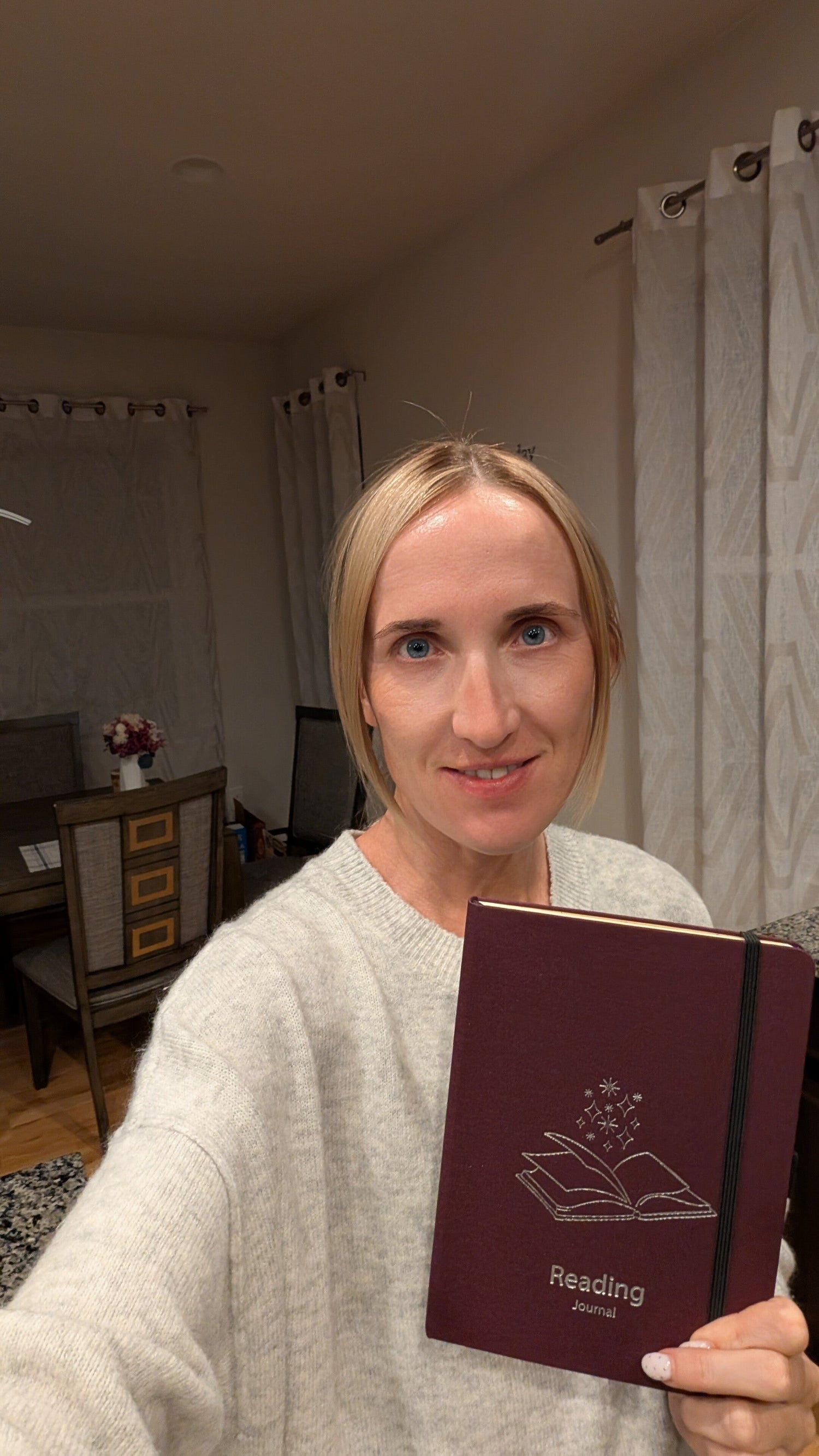
Last updated: July 2026 | A practical guide to reading slump tips, how to start reading again, book journal ideas, reading lists, and using a Dingbats* Reading Journal to make books feel inviting again
Sometimes, reading stops feeling easy.
You want to read.
You like the idea of reading.
You may even have a stack of books waiting for you.
But every time you open one, your mind wanders. You read the same paragraph three times. You start a book and abandon it after a few pages. You keep buying books because you want to be the kind of person who reads, but actually sitting down with one feels strangely difficult.
That is a reading slump.
And it does not mean you stopped loving books.
It usually means reading has started to feel heavier than it should. Maybe you are tired. Maybe you chose the wrong book for your current mood. Maybe life has been too full. Maybe your attention is scattered. Maybe reading quietly became another thing you feel you “should” be doing, instead of something you actually want to return to.
The way out of a reading slump is not to force yourself through a book you are not enjoying.
It is to make reading feel inviting again.
At Dingbats*, we created the Reading Journal for exactly this kind of relationship with books: not perfect reading, not performative reading, but thoughtful reading. It gives you space to track what you read, reflect on the books that move you, collect favorite quotes, build reading lists, try reading challenges, compare books to film adaptations, and understand what kind of reader you actually are.
A reading slump does not need a dramatic fix.
Sometimes, it only needs one good book, ten quiet minutes, and a page that makes reading feel personal again.
Quick Overview: How to Get Out of a Reading Slump
| Reading Slump Problem | What to Try | How a Reading Journal Helps |
|---|---|---|
| You cannot focus | Read for 10 minutes only | Track small reading sessions |
| You chose the wrong book | Switch genres or moods | Create a mood-based reading list |
| Reading feels like homework | Stop forcing difficult books | Write honest book notes |
| You keep abandoning books | Try a DNF page | Notice what is not working |
| You do not know what to read | Reread an old favorite | Make a “books that brought me back” page |
| You miss loving books | Save favorite quotes | Reconnect with why books matter to you |
| You want structure | Use logs and trackers | Build a simple reading habit |
| You want something fun | Try book-to-film comparisons | Make reading feel playful again |
Getting out of a reading slump is not about reading more immediately. It is about making reading feel good enough to return to.
What Is a Reading Slump?
A reading slump is a period when reading feels difficult, boring, overwhelming, or impossible, even if you usually enjoy books.
It can look like:
- starting books but not finishing them
- buying books but not reading them
- rereading the same page without absorbing it
- avoiding books even though you miss reading
- feeling guilty for not reading enough
- only reading when you “force” yourself
- losing interest in genres you normally enjoy
- scrolling instead of picking up a book
- feeling like no book is the right book
A reading slump can last a few days, a few weeks, or much longer. But it is not a failure.
It is usually a sign that your reading life needs a softer entry point.

Why Reading Starts to Feel Hard
Reading is quiet.
That is part of its beauty, but it is also why it can feel hard when life is loud.
To read, you need attention. You need a little space. You need enough mental energy to enter another world, follow an argument, care about characters, or sit with someone else’s thoughts.
When you are tired, distracted, stressed, busy, or overstimulated, reading can start to feel like effort.
There are also other reasons reading slumps happen.
| Reason | What It Can Feel Like |
| You picked the wrong book | Every page feels slow |
| You are forcing a genre | You keep losing interest |
| You are too tired | Reading makes you sleepy immediately |
| Your attention feels scattered | You cannot stay with the page |
| You feel pressure to read “better” books | Reading becomes performance |
| You are comparing yourself to other readers | Reading feels like a competition |
| You finished an amazing book | Nothing else feels good enough |
| You are in a busy life season | Reading gets pushed aside |
The first step is to stop treating the slump like a discipline problem.
Most of the time, you do not need more pressure.
You need a better doorway back in.
Stop Forcing the “Right” Book
One of the biggest mistakes people make in a reading slump is trying to restart with the book they think they should read.
The serious book.
The classic book.
The long book.
The book everyone is talking about.
The book that has been on the shelf for two years.
The book they started and feel guilty about not finishing.
Sometimes that works.
Often, it does not.
A reading slump is not always the best time to challenge yourself. It is often the best time to choose something that feels easy to enter.
That might mean:
- a short book
- a fast-paced novel
- a familiar author
- a reread
- a book of essays
- a graphic novel
- a romance
- a mystery
- a memoir
- a book connected to a film or show
- a book with very short chapters
- a book that matches your current mood
The “right” book is not always the most impressive one.
It is the one you actually want to pick up.
Start With a Short, Easy, or Familiar Book
If reading feels hard, lower the barrier.
Choose a book that makes starting feel simple.
Short books can help because they give you momentum. Familiar books can help because they remove pressure. Easy books can help because they remind you that reading is allowed to be enjoyable.
Books That Can Help With a Reading Slump
| Book Type | Why It Helps |
| Short novel | Feels easier to finish |
| Reread | Brings comfort and familiarity |
| Fast-paced mystery | Creates momentum |
| Romance or cozy fiction | Feels inviting and low-pressure |
| Graphic novel | Combines visual and written storytelling |
| Essays or short stories | Lets you read in small pieces |
| Memoir | Can feel personal and conversational |
| Book with short chapters | Easier to read in small sessions |
| Favorite childhood or teen book | Reconnects you with early reading joy |
This is a good place to use your Dingbats Reading Journal*.
Create a page called:
Books That Might Bring Me Back
Then list books that feel easy, familiar, or genuinely appealing right now.
Not books you think you should read. Books you might actually open tonight.
Build a 10-Minute Reading Ritual
You do not need to read for an hour to start reading again.
Try ten minutes. Ten minutes is short enough to feel manageable, but long enough to re-enter the habit.
The 10-Minute Reading Ritual
| Step | What to Do |
| 1 | Choose a book that feels easy to start |
| 2 | Put your phone away or out of reach |
| 3 | Set a timer for 10 minutes |
| 4 | Read without trying to finish anything |
| 5 | Write one line in your Reading Journal afterward |
That final line matters because it helps the reading session feel complete.
It could be:
- “This was easier than I expected.”
- “I liked the atmosphere.”
- “Not the right book for today.”
- “The first chapter pulled me in.”
- “I want to continue tomorrow.”
- “I only read a little, but I started.”
A reading journal does not need to be complicated.
Sometimes one line is enough to keep the thread going.

Use a Reading Journal Without Pressure
A reading journal should not make reading feel like homework.
It should make reading more enjoyable, more memorable, and more personal.
The Dingbats* Reading Journal is designed as a thoughtful companion for readers. It includes space for reading logs, book review pages, favorite quotes, reading challenges, library and tracker pages, book-to-film comparison tables, a built-in bookmark, an end pocket, and smooth 100gsm fountain-pen-friendly paper.
But you do not need to use every page at once.
Start with one simple section.
Low-Pressure Reading Journal Ideas
| Page | How to Use It |
| Reading log | Track the books you start and finish |
| Book review page | Write a short, honest response |
| Favorite quotes | Save lines that stayed with you |
| Mood-based reading list | Choose books by feeling |
| Reading tracker | Notice consistency without pressure |
| DNF page | Understand why a book was not right |
| Book-to-film comparison | Make reading feel playful |
| Library page | Track books you own, borrow, or want |
A reading journal works best when it supports your reading life, not when it turns it into a performance.
Make a Mood-Based Reading List
Sometimes the problem is not that you do not want to read. It is that you do not know what kind of reading you need.
A mood-based reading list helps you choose based on how you want to feel, not just what genre the book belongs to.
Mood-Based Reading List
| If I Want To Feel… | I Could Read… |
| Comforted | A familiar favorite |
| Curious | Non-fiction or essays |
| Swept away | Fantasy, romance, or adventure |
| Calm | Gentle fiction or nature writing |
| Inspired | Memoir or creative non-fiction |
| Entertained | Mystery, thriller, or fast-paced fiction |
| Understood | Literary fiction or personal essays |
| Playful | Graphic novel or book-to-film read |
In your Reading Journal, create a page called:
What Kind of Book Do I Need Right Now?
Then write categories like:
- something easy
- something emotional
- something funny
- something short
- something beautiful
- something addictive
- something familiar
- something completely different
This makes choosing your next book feel less overwhelming.
Try the “First Chapter Test”
If you keep getting stuck, stop committing too early. Try the first chapter test.
Pick three books. Read the first chapter of each. Then choose the one you actually want to continue.
This removes the pressure of choosing the perfect book before you begin.
First Chapter Test Template
| Book | First Impression | Do I Want to Continue? |
You may be surprised by what pulls you in.
Sometimes the book you thought you should read feels wrong, while the unexpected one feels easy.
That is useful information.
Your Reading Journal can help you notice what your attention is naturally drawn to.

Create a DNF Page
DNF means “did not finish.”
Many readers feel guilty about not finishing books, but a DNF page can actually help you understand your taste better.
Not every unfinished book is a failure.
Sometimes the timing is wrong.
Sometimes the pacing is too slow.
Sometimes the writing style does not connect.
Sometimes the topic is not what you need right now.
Sometimes the book is good, but not for you.
DNF Page Template
| Book | Why I Stopped | Try Again Later? |
This kind of page can be freeing.
It teaches you what does not work for you, which makes it easier to choose books that do.
A reading slump often continues because people keep forcing books that do not fit.
Letting go of the wrong book can be the fastest way back to reading.
Reread Something You Loved
Rereading can be one of the best ways out of a reading slump.
There is comfort in returning to a book you already know. You do not have to work as hard to enter the world. You already trust the story. You already know there is something inside it for you.
Rereading can remind you why you loved reading in the first place.
In your Reading Journal, reflect on the:
Books That Made Me a Reader
List the books that shaped you, surprised you, comforted you, or made you excited to keep turning pages.
This page is especially useful when reading feels distant.
It brings you back to your own history with books.
Read Somewhere Different
Sometimes the book is not the problem. The setting is.
If you always try to read in bed when you are already exhausted, you may start associating reading with falling asleep. If you only read when you feel guilty for not reading, you may associate reading with pressure.
Try changing the place.
Places to Read When You Feel Stuck
| Place | Why It Helps |
| Café | Adds atmosphere and focus |
| Park | Makes reading feel slower |
| Balcony or garden | Adds calm and light |
| Library | Creates a reading environment |
| Train or commute | Turns waiting into reading |
| Sofa with a drink | Makes it feel comfortable |
| Desk | Helps if you want more focus |
| Outside in the morning | Makes reading feel fresh |
Afterward, write one line in your Reading Journal:
Where I read today:
How it felt:
Sometimes a new place is enough to make reading feel new again.
Try Book-to-Film Comparisons
Reading does not always have to feel serious.
Sometimes the way back into books is to make it fun.
A book-to-film comparison is a great reading slump tool because it gives you a built-in reason to finish: you get to compare the book with the adaptation.
The Dingbats* Reading Journal includes book-to-film comparison tables, which are perfect for this.
Book-to-Film Comparison Ideas
| What to Compare | Notes |
| Characters | Who felt different on screen? |
| Setting | Did the film match the atmosphere? |
| Ending | What changed? |
| Favorite scene | Which version did it better? |
| Missing details | What did the film leave out? |
| Overall feeling | Which one stayed with you more? |
This can make reading feel more interactive. It turns the book into part of a wider experience.
Track What You Actually Enjoy
A reading journal is not only for tracking how many books you read.
It can help you understand your taste.
That matters because many reading slumps come from choosing books based on pressure rather than pleasure.
Track what you actually enjoy.
Reading Taste Tracker
| Book | What I Liked | What I Did Not Like | What I Want More Of |
After a few entries, you may notice patterns.
Maybe you love short chapters.
Maybe you prefer character-driven stories.
Maybe you need strong settings.
Maybe you like books with emotional warmth.
Maybe you dislike overly slow openings.
Maybe you love books that feel cinematic.
Maybe you prefer non-fiction when life feels busy.
Knowing your taste makes it easier to choose the next book.
And choosing better books makes reading easier to continue.
Make Reading Feel Like a Ritual Again
A reading ritual does not need to be elaborate.
It just needs to make reading feel inviting.
Simple Reading Ritual Ideas
| Ritual | How to Do It |
| 10 pages before bed | Keep the book nearby |
| Coffee and one chapter | Read before opening your laptop |
| Sunday reading hour | Make it a weekly reset |
| Read outside | Add light, air, and calm |
| One chapter after dinner | Create a transition into evening |
| Café reading date | Take yourself somewhere to read |
| Book and journal pairing | Write one line after each session |
The ritual matters because it removes the question of when reading happens.
It gives reading a place in your life again.
How the Dingbats* Reading Journal Helps
The Dingbats* Reading Journal is designed for readers who want to track, reflect, and build a more intentional reading habit.
It is not only a log of books finished. It is a place to understand your reading life.
Dingbats* Reading Journal Features
| Feature | How It Helps During a Reading Slump |
| Reading logs | Track progress without relying on memory |
| Book review pages | Reflect honestly on what worked |
| Favorite quote sections | Save lines that reconnect you with books |
| Reading challenges | Add playful structure |
| Library and tracker pages | Organize books you own, borrow, or want |
| Book-to-film comparison tables | Make reading feel more interactive |
| Built-in bookmark | Keep your place easily |
| End pocket | Store notes, tickets, small paper memories |
| Smooth 100gsm fountain-pen-friendly paper | Makes writing feel enjoyable |
The journal is there to support the reader, not judge the reader.
You can use it every day, once a week, or only when you finish a book.
The best reading journal is the one that makes you want to keep reading.
Reading Slump Prompts
Use these prompts when you want to understand your slump and gently restart.
| Prompt | What It Helps With |
| What kind of book do I actually want right now? | Choosing better |
| What book feels easy to start? | Lowering pressure |
| What made me stop reading recently? | Identifying obstacles |
| What book first made me love reading? | Reconnecting |
| What genre sounds comforting? | Matching mood |
| What am I forcing myself to read? | Letting go |
| Where would reading feel most inviting? | Changing environment |
| What did I like about the last book I enjoyed? | Understanding taste |
| What is one book I can try for 10 minutes? | Starting small |
| What would make reading feel fun again? | Bringing back joy |
These prompts are not tests.
They are small doors back into books.

Frequently Asked Questions
What is a reading slump?
A reading slump is a period when reading feels difficult, boring, overwhelming, or hard to start, even if you normally enjoy books.
How do I get out of a reading slump?
Start with a short, easy, familiar, or exciting book. Read for only 10 minutes, stop forcing books that do not fit, try a new reading environment, and use a reading journal to track what you actually enjoy.
Should I force myself to finish a book?
Not always. If a book is making reading feel worse, it may be better to stop and choose something else. A DNF page can help you understand why the book was not right for now.
What should I read during a reading slump?
Try a short book, reread an old favorite, choose a fast-paced novel, read essays or short stories, pick a graphic novel, or choose a book based on your mood rather than what you think you should read.
Can a reading journal help with a reading slump?
Yes. A reading journal can help you track progress, understand your taste, create low-pressure reading lists, save favorite quotes, reflect on books, and make reading feel more personal and enjoyable.
What makes the Dingbats* Reading Journal useful?
The Dingbats* Reading Journal includes reading logs, book review pages, favorite quote sections, reading challenges, library and tracker pages, book-to-film comparison tables, a built-in bookmark, an end pocket, and smooth 100gsm fountain-pen-friendly paper.
Our Verdict
A reading slump does not mean you are no longer a reader.
It usually means reading needs to feel lighter, easier, and more inviting again.
Choose the book that calls to you, not the one that impresses you. Read for ten minutes, not two hours. Let go of the book that is not working. Reread something that once made you love stories. Change where you read. Make a list based on mood, not pressure.
And when you do read, write a little of it down.
The Dingbats* Reading Journal gives your reading life a place to return to. It helps you track books, save quotes, reflect on what you loved, compare books to films, organize your library, and notice what kind of reader you are becoming.
You do not need to read more perfectly. You only need to find your way back to the page.
One book.
One chapter.
One quiet moment.
One line in your journal.

Leave a comment
All comments are moderated before being published.
This site is protected by hCaptcha and the hCaptcha Privacy Policy and Terms of Service apply.